Saturday, March 27, 2010

Mystery animal


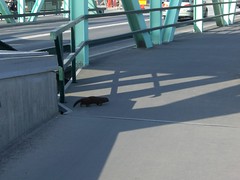
Critter on bridge
Originally uploaded by Kristjan Wager
I encountered this animal on my way to work yesterday (in Malmö, Sweden) - I think it's related to a ferret as it moves and looks the same way, but I am not sure what sort of animal it is. Can anyone identify it?

There are two more images at it here and here.

Update: Some of facebook friends identified it as a mink. It doesn't appear to be native to Sweden, so it has probably been released at some stage.

Labels: ,

Monday, April 06, 2009

Short news, endangered species edition

While browsing around on National Geographic I came across two pieces of news related to endangered species.

Guantanamo's Wild Side: Huge Boas, "Banana Rats," More

It turns out that the US military base at Guantanamo Bay is the home of a lot of wildlife, much of which is endangered, or at least threatened. They obviously don't live in the prison camp, but in the military base as a whole, specially the more remote parts.

6,000 Rare, Large River Dolphins Found in Bangladesh

A previously unknown population of Irrawaddy dolphins discovered in Bangladesh has given scientists "great hope" for the survival of the rare species, conservationists said Wednesday.

A research team estimated that 6,000 Irrawaddy dolphins thrive in the country's Sundarbans mangrove forests and nearby waters of the Bay of Bengal.


This is obviously great news as well, and we can hope it's possible to protect this population, to ensure the survival of the species.

Labels: , , ,

Monday, March 24, 2008

Whales in the news

Two pieces of whale news mentioned over at Talk Rational that I found interesting.

Scientists spot white killer whale off Alaska

That's quite interesting, especially since it seems like it's not a true albino. The other story, however, is even more interesting.

NZ dolphin rescues beached whales

Quite remarkable.

Labels: , ,

Thursday, March 20, 2008

Why medical experiments matter

A couple of days ago, Orac wrote a long post about animal testing - Bad scientific arguments in the service of "animal rights" activism.

Personally, I dislike furs and am against unnecessary animal testing ("unnecessary" of course being the hard-to-define keyword). Necessary testing, such as medical testing, on the other hand, I'm all for, and Orac gives many good arguments for why I should continue endorsing it.

One of the good examples that Orac mentions Dr. Judah Folkman, who did some critical cancer research on mice.

Folkman found a mouse tumor model that mimicked this behavior and in the early 1990s did a series of pioneering experiments. In a strain Lewis lung carcinoma cells of low metastatic potential (LLC-LM), when cells are injected into C57BL/6 mice and allowed to grow subcutaneously, if the tumor is left alone, mice develop only microscopic lung metastases. These metastases do not grow and kill the mouse. If, however, the primary cancer is removed, then many large lung metastases grow rapidly. The results of the experiment above strongly implied that the primary tumor is secreting something that suppresses the growth of microscopic metastases. After this, the Folkman group did what we like to call "brute force" science, collecting mouse urine and analyzing it for tumor suppressive activity until they were able to purify a single 38 kDa peptide, which they designated angiostatin. This involved analyzing literally gallons of mouse urine. (Who said science isn't glamorous?) Once Folkman's group had a bunch of angiostatin on hand, it peformed the following experiment. Two groups of mice were injected with LLC-LM and the tumors allowed to grow to a certain size, after which they were surgically removed. One group was treated with angiostatin, and the control group with saline. The result was that the control group developed massive lung metastases and died, while the group treated with angiostatin had microsocopic lung metastases that never grew beyond a ball of cells. Dr. Folkman then demonstrated that it was the inhibition of angiogenesis by the angiostatin that kept these tumors in check. Ultimately, he used a similar method to discover endostatin, and later he demonstrated that endostatin could induced tumor dormancy in mice. I trust that the reader can see how these seminal preclinical observations about angiogenesis would have been virtually impossible without animal models, given that angiogenesis requires the interaction between tumor cells, cells in blood vessels, and the surrounding tissue stroma to occur.


Of course, after this was done, Folkman could move on to testing on humans, but the animal testing was vital.

Just to put Orac's example into perspective, the very next day the NY Times, had an article about one of the humans involved in the tests - A Daring Treatment, a Little Girl’s Survival. The treatment is still being researched, and the data is so far anecdotal, but it seems promising. This means that it looks like Folman's experiments on mice will end up saving the lives of many humans, including the small girl mentioned in the NY Times article.

I'm sorry, but if I have to choose between humans and laboratory breed mice, I'll go for the humans.

Labels: , , , , ,

Sunday, February 03, 2008

Killer dolphins

Murderous dolphins. Those two words don't go together in most peoples' opinion. Yet, we now know that dolphins are not necessarily the peaceful animals that their image project.

The Telegraph reports: Killer dolphins baffle marine experts

New evidence has been compiled by marine scientists that prove the normally placid dolphin is capable of brutal attacks both on innocent fellow marine mammals and, more disturbingly, on its own kind.

Film taken of gangs of dolphins repeatedly ramming baby porpoises, tossing them in the air and pursuing them to the death has solved a long-term mystery of what causes the death of so many of these harmless mammals - but has left animal experts baffled as to the motive.

Another mystery is that the animal 'murders' have only been reported in two parts of the world - along Scotland's East Coast and in America off the beaches of Virginia, where even more alarmingly, the victims were scores of the dolphins' own young.


Of course, this is hardly news, so I wonder why the Telegraph present it as such. We also know that male dolphins gang up and rape female dolphins. All in all, dolphins are pretty good at PR.

Labels: ,

Saturday, March 03, 2007

Crimes against nature?

Some how I had overlooked this piece of news.

Australia rocked by 'lesbian' koala revelation

Female koalas indulge in lesbian "sex sessions", rejecting male suitors and attempting to mate with each other, sometimes up to five at a time, according to researchers.

The furry, eucalyptus-eating creatures appear to develop this tendency for same-sex liaisons when they are in captivity. In the wild, they remain heterosexual


Somehow I am a little doubtful about the last sentence. My guess would be that this behaviour hasn't been observed in nature, but that it still goes on. It's somewhat easier to monitor animals in captivity than in the wild - and no one has probably thought of looking for the behaviour in the wild.

Of course, Koalas are just the latest in a long list of species displaying bi- or homosexual behaviour. Which makes the whole idea of homosexuality being "against nature" quite foolish, but since when has that stopped fundamentalists?

Labels: , ,

Monday, February 26, 2007

New animals found under the Antarctic

The Guardian has an interesting article on the subject. It turns out that because of the melting ice, scientists can access areas that couldn't be accessed before.

Yahoo also has an article, with some cool pictures (the later link via Pharyngula) .

Labels: ,

Friday, February 23, 2007

Planets of the Apes coming closer?

Via one of the commenters at Pharyngula (sorry, lost the link, so can't say who it was), who pointed to a post at Liberal Values, I see that Chimpanzees are showing one of the classic examples of intelligence. Sophisticated tool using. Well, weapon using actually.

At Yahoo: Hunting chimps may change view of human evolution

Chimpanzees have been seen using spears to hunt bush babies, U.S. researchers said on Thursday in a study that demonstrates a whole new level of tool use and planning by our closest living relatives.

Perhaps even more intriguing, it was only the females who fashioned and used the wooden spears, Jill Pruetz and Paco Bertolani of Iowa State University reported.


This might lead to some re-evaluation of some longheld beliefs.
As Jill Pruetz explains:

The observation that individuals hunting with tools include females and immature chimpanzees suggests that we should rethink traditional explanations for the evolution of such behavior in our own lineage," she concluded in her paper.


That's quite interesting.
Note that she is speaking of the evolution of the gender roles, and not the biological process leading to Homo Sapiens, as the headline of the article might lead you to think.

Washington Post has more.

Labels: