Thursday, May 13, 2010

Health Care Reform: The Morning After

Note: This is a first for this blog. A guest post by someone else. Generally speaking, this is not something I plan on happening a lot, but when Barbara asked me if I was interested, I found the post interesting enough, but also relevant to the subjects I normally touch on on this blog.


Many politicians and pundits warned us that the health care reform (HCR) legislation that just became law will destroy America. Government bureaucrats will take over health care decisions, we were told. The old and infirm would be hauled away by death panels. Everything about the way we receive our medical care will change, and change drastically, they said.

Medicare recipients have been frightened by stories that their benefits will be cut. Middle-age people are worried they will lose their jobs when the law’s dreaded regulations, or taxes, or maybe regulations with taxes, would destroy their employers’ businesses.

The truth is, very little will change for most people. If you were insured by employee benefits before HCR, you will be insured by exactly the same policy in exactly the same way after HCR. You will have access to the same doctors on the same terms. “Government bureaucrats” will no more be involved in your health care than they were before.

And the same is true of Medicare, which of course is a government program, although many of the people who opposed the HCR bill don’t seem to know that.

Here are the “cataclysmic” changes to health care that are now in effect, or which will go into effect within the next six months for people who are already in group insurance plans:


  • The law says you can’t lose your insurance coverage because you get sick. Before, in many states, if you were stricken with a severe illness such as mesothelioma cancer that would be expensive to treat, your insurer could use just about any excuse to cancel your coverage. That is over.

  • HCR has ended lifetime limits on coverage. As long as you are receiving medical care, your insurer pays the bills.

  • Your children can be covered on your existing policy until they are 26 years old.

  • In six months, insurers cannot refuse to insure people under the age of 19 because of “pre-existing conditions.” This provision will go into effect for everyone in 2014.


And if you are on Medicare, you will be asked to struggle with the following:


  • You get a free annual checkup.

  • The co-pays and deductibles on many preventive care services are eliminated.

  • If you are in the Medicare D “doughnut hole,” you will get a $250 rebate check in a few weeks. The hole itself will be closed gradually and will be gone by 2020.


But what about all those terrible regulations and taxes that are about to drive businesses out of business? Um, there really isn’t much to report. Oh, wait, here’s one — a 10 percent tax on indoor tanning services that use ultraviolet lamps will go into effect July 1. That’s about it.

However, beginning this year a tax credit will be available for some small businesses to help provide insurance coverage for employees.

Soon the politicians and pundits will start trying to frighten you about the provisions that will go into effect after this year. I assure you they are about as scary as the provisions that go into effect this year, but I will discuss them in a follow-up post.

Barbara O’Brien
Barbara O'Brien is a popular blogging advocate and left wing blogger who writes the blog Mahablog. O'Brien is a strong advocate of blogging as a means of giving the public power in the media, as well as opposing the Iraq war. She has a Bachelor of Journalism from the University of Missouri

Labels: ,

Monday, March 22, 2010

Is perfect the enemy of the barely good enough?

So, it seems that the US finally got its health care reform - and as Obama said, “This isn’t radical reform, but it is major reform.” The problem is of course, that many felt (myself included) that the US needed a radical reform, not a major reform.

The health care system in the US is broke - it's the most expensive health care system in the world, yet the US patients seem to be getting sub-par health care for all that money - perhaps because of the amount of money spent on administration of insurances. On top of that, a large portion of the US population is uncovered, and the no 1 cause of bankruptcies in the US is still related to health care costs.

Taking all these things into consideration, it's hard to be too happy about the health care reform, which barely addresses these issues. Yes, there are some very good things in the reform (e.g. not allowing the insurance companies to refuse coverage to people with pre-existing conditions from childhood, and not allow them to drop coverage of people who become sick), but there are also some really horrible things in it (the dependency on insurance companies, the anti-abortion provision).

Even having stated all my reservations, I am glad that it finally looks like some kind of health care bill will pass. Yes, it's barely good enough for it to be considered any kind of improvement on the current situation, but that's because we wanted so much more. Any bill which extends health care coverages for tens of millions is definitely a step in the right direction.

And with the danger of going all real-politic on you, it's important to take the current political situation into consideration. Currently the Republicans are the party of No, refusing any kind of bi-partisanship. This means that the Democrats have to find the votes within their own ranks, which means convincing some of the DINOs to vote for the bill. This will unfortunately compromise the progressiveness of the bill, allowing things like the anti-abortion provision to be included. Hopefully these deficiencies can be corrected at a later stage.

So, to answer this post's title - yes, waiting for the perfect would have been a bad move. This was what caused the health care reform to fail during Nixon. A health care reform which would have been much more progressive than the current reform in the works.

Labels: ,

Sunday, November 08, 2009

Will the US finally get universal health care?

I have never hidden my stance on universal health care. I am completely in favor it. What's more, I consider it an atrocity that any western country can have millions of citizens who haven't got basic health care coverage.

It looks like the US has finally realized this as well. Obama made it one of his key issues during the election (as did the other Democratic candidates), and has been working hard to get it through since he stepped into office. What's more, every poll shows that the majority of the US population backs his efforts.

Now, it looks more likely that this effort will become successful.

The US congress has voted 220-215 for expanding health care coverage in the US.

This was a largely partisan vote, with 219 Democrats, and only 1 Republican, voting for the expansions, and 39 Democrats and 176 Republicans voting against the expansion. You can see how the members voted here. Note the names of the people who voted against, especially the Democrats. These are the people who want millions of US citizens to continue not having health care coverage. Remember this during the next election - these people don't have the best interest of the voters in mind.

The battle is not over yet - the bill has to pass the senate - but it is a lot closer now than a few days ago.

There is much not to like about the bill which passed in the Congress. I don't like the reliance on insurance companies, and I hate the anti-abortion amendment, which the anti-choice members of the Congress got introduced. Yet, even with these flaws, there is much to like, e.g. the abolition of preexisting conditions. It's a good first step, and hopefully the Democrats won't stumble now.

Labels: ,

Friday, September 07, 2007

Mentally ill children given up for foster care

Via Readerville, I became aware of this.

Mental Illness Sends Many to Foster Care

Almost one of every four children in Virginia's foster care system is there because parents want the child to have mental health treatment, a report commissioned by the General Assembly states.

The study -- the result of a months-long examination of the state's foster care and mental health services -- chronicles the difficult decisions that thousands of Virginia parents have made to relinquish custody of their children to the foster care system so they can get mental health services that are otherwise unavailable or unaffordable.


We are speaking of up towards 25% of all foster children in Virginia, or, going by the numbers in the article, 23%. 23%. That's 2008 children. If mental health care had been freely available for free (or at an income based cost), there would be 23% less foster children in Virginia.

And it's not isolated to Virginia.

Last year, the federal government found that at least 12,700 children were placed in foster care or juvenile jails only because they needed mental health treatment. The study called it a significant problem in every state.


Given the numbers from Virginia, I think it's safe to adjust that number quite a bit upwards.

This is an example of the human costs of the lack of an affordable health care system (such as universal health care), which ends up costing society a lot more in the long run.

Labels: ,

Sunday, April 22, 2007

Infant Deaths on the rise in the US

As I have mentioned before, the US have the highest infant mortality in the Western World. Now, there is some distrubing news in the NY Times - In Turnabout, Infant Deaths Climb in South

For decades, Mississippi and neighboring states with large black populations and expanses of enduring poverty made steady progress in reducing infant death. But, in what health experts call an ominous portent, progress has stalled and in recent years the death rate has risen in Mississippi and several other states.

The setbacks have raised questions about the impact of cuts in welfare and Medicaid and of poor access to doctors, and, many doctors say, the growing epidemics of obesity, diabetes and hypertension among potential mothers, some of whom tip the scales here at 300 to 400 pounds.

“I don’t think the rise is a fluke, and it’s a disturbing trend, not only in Mississippi but throughout the Southeast,” said Dr. Christina Glick, a neonatologist in Jackson, Miss., and past president of the National Perinatal Association.

To the shock of Mississippi officials, who in 2004 had seen the infant mortality rate — defined as deaths by the age of 1 year per thousand live births — fall to 9.7, the rate jumped sharply in 2005, to 11.4. The national average in 2003, the last year for which data have been compiled, was 6.9. Smaller rises also occurred in 2005 in Alabama, North Carolina and Tennessee. Louisiana and South Carolina saw rises in 2004 and have not yet reported on 2005.


As the article states, the rise seems to correlate with race.

Most striking, here and throughout the country, is the large racial disparity. In Mississippi, infant deaths among blacks rose to 17 per thousand births in 2005 from 14.2 per thousand in 2004, while those among whites rose to 6.6 per thousand from 6.1. (The national average in 2003 was 5.7 for whites and 14.0 for blacks.)


Given how socio-economical factors and race correlates, I think it can be said that infant mortality correlates with socio-economical factors (the poorer the mother is, the higher the infant mortality).

Some of this might tie in to the lack of health care for the women involved, though poor women generally can get free prenatal care. As Dr. Bouldin Marley says

“I don’t think there’s a lack of providers or facilities,” he said. “Some women just don’t have the get up and go.”


Dr. Marley doesn't seem to understand that poor people don't always have the opportunity to take time off "to go". As Barbara Ehrenreich described in Nickel and Dimed, many poor people have to work several jobs just to get by.

And there are other factors involved. One of people interviewed in the article makes clear that availability of health care is not enough, if it there is no way for the people to go there.

But social workers say that the motivation of poor women is not so simply described, and it can be affected by cuts in social programs and a dearth of transportation as well as low self esteem.

“If you didn’t have a car and had to go 60 miles to see a doctor, would you go very often?” said Ramona Beardain, director of Delta Health Partners. The group runs a federally financed program, Healthy Start, that sends social workers and nurses to counsel pregnant teenagers and new mothers in seven counties of the Delta. “If they’re in school they miss the day; if they’re working they don’t get paid,” Ms. Berdain said.


While I keep talking about universal health care as a solution, it cannot stand alone. There must be some kind of safety net that can protect people from proverty if they need health care or if they use preventive health care. The later is probably a pretty good investment for society, as it reduces costs in the long run.

Now, will the so-called pro-life politicans do something about this?

Labels: , ,

Saturday, April 21, 2007

The disparity between coverage on school shootings and health care deaths

Over at Huffington Post, Richard Eskow talks about the disparity between the coverage of tragedies like the shooting at Virginia Tech and the average deaths of between 40 or 50 people due to lack of proper health care.

The Unseen Dead: Virginia Tech and Health Policy

My heart breaks for the 33 people who died Monday. It also breaks for the estimated 50 Americans who died on the same day as a result of inadequate health coverage. Most of them had families who loved them, too. Where is their candlelight vigil? Where are their Presidential eulogies, or their exhaustive television coverage?

Instead of receiving their moment of silence, these invisible dead face an eternity of silence.

Lack of health insurance results in the deaths of 18,000 Americans each year, according to studies compiled by the National Academies' Institute of Medicine. That equates to 49 or 50 deaths every day. As the Institute has documented, deaths result from late identification of curable cancer and other conditions, and from inadequate treatment for a range of illnesses that include renal disease and other chronic conditions.

Many of those who die as a result of inadequate health care are older, in contrast to the young lives so full of promise that were cut down this week. But not all. The United States has the worst infant mortality of any industrialized country in the world except Latvia. The shadow of death falls disproportionately on African-Americans, whose infant mortality rate is 2.5 times that of non-hispanic whites.
While I agree with Eskow that there should be more coverage on the issue of the many uninsured and the many unnecessary deaths, I think it is important to notice that grief and compassion is not a zero-sum game. Also, it is a common instinct to react more strongly to sudden spetacular losses, like those resulting from a catastrophe or terrorist act, than to
the more silent long-drawn ones. Just look at the reaction to the Tsunami, where aid poured in, while the many health and food crises around the world were ignored for the nth year. And there is also the fact that people feel more strongly about things affecting people they can (and want to) identify with.

Is it fair that this happens? No, of course not, but unfortunately it's human nature. Still, it's good to have people like Eskow there to draw our attention to the other, more silent, tragedies that can be prevented.

California is going in the right direction towards this, though there is a long way yet. Sheila Kuehl's SB 840 passed the Californian Senate Health Committee, as did it's companion bill SB 1014 (which describes the funding). Both were passed on a 6-4 vote.
The bill has a way to go, but have widespread support from many itnerest groups, including some not traditionally on the side of universal health care.

Note: For those who feel that Eskow is wrong in using the Virginia Tech shooting to draw attention to other issues, I recommend reading this piece by Lindsay Beyerstein

Labels: ,

Why health care is a feminist issue

This is why health care in general, and a move towards universal health care, is a feminist issue.

U.S. women with health insurance are more likely than men to go without needed care because of higher premiums and related costs, a study said. A larger percentage of women also have trouble paying their medical bills.

More women didn't fill prescriptions, skipped recommended visits with specialists, failed to get tests, or just didn't seek treatment when they had a medical problem, according to a national survey by the Commonwealth Fund, a private, New York- based group that supports research on health and social issues.

Other studies have suggested that women often pay more for care because they need more routine exams, such as those related to pregnancy. These issues should be part of the national debate as employers switch to plans with higher deductibles and policy makers seek flexible, lower-cost options for 44 million uninsured and 16 million ``underinsured'' adults, the report said.


So, due to the fact that health care is more expensive for women, they are less likely to be insured. Combine this with the fact that women are less likely to have a job which includes health care than men, and we have a real problem.

Of course, there is also the problem that women earn less than men.

More than 4,000 adults ages 19 and older participated in the survey, researchers said. Of that number, 33 percent of insured women and 68 percent of uninsured didn't get the health care they needed because they couldn't afford it, compared with 23 percent of insured men and 49 percent of uninsured men who went without care.

Among full-time workers, women earn 77 cents for every dollar men earn, according to the most recent Labor Department figures.

``The combination of lower incomes and higher out-of-pocket spending means that many women are more likely to spend greater than 10 percent of their income on health-care expenditures and premiums,'' Patchias and Waxman wrote in the report.

Almost 38 percent of all women surveyed reported difficulty paying medical bills, compared with 29 percent of men, the report said. Among the insured, 31 percent of women had trouble with bills compared with 22 percent of men. About a quarter of the women said they weren't able to pay their bills at all, and about the same percentage said they're paying them off over time.


Some people might argue that the real wage difference between men and women is lower than the article indicates. This is correct, but it is still lower, even if we take other factors into account. And it's really irrelevant since we are talking about medical costs compared to total income, which is higher (medical costs) and lower (total income) for women compared to men.

I've said it before, and I'll say it again. The US health care system is broken, and needs to be fixed. One good solution would be to introduce universal health care of some kind in the US.

Labels: , , ,

Tuesday, April 03, 2007

Why is health care so expensive in the US?

Often the debate about reducing the cost of health care in the US focuses on tort reform, as to reduce the costs of doctors and hospitals. This has however always seemed wrong to me, as the malpractice suits costs very little compared to the total costs (as Dwight Meredith made clear in this old post at PLA), and the insurance amounts for something like 3% of the doctors' total costs. In other words, while malpractice suits and malpractice insurance costs might have an effect on the total health care costs, they are obviously insignificant compared to other factors.

Now I see that the PNC Financial Group has made a survey of health care in the US, which shows that health care administration consumes nearly one-third of health care costs. And it according to the hospitals and insurance companies.

The press release is a little unclear if we are talking total health care costs, or just private expenditures on health care. However, if we consider that in 2003, the US spent $5771 per capita on health care, that would mean that up towards $1900 was used on administration. Or in total numbers - the US health care costs totalled $1.7 trillion in 2003, which means that about $0.6 trillion was spent on adminstration.

Or if we look at private expenditure, which accounts for 55.4% of the total health care expenditure, it would mean that private citizens (and their insurance companies) used approximately $0.3 trillion on adminstration. Much of this adminstration was caused by the insurance companies, which leads to the hospitals having to increase their prices, to cover it, which leads to higher insurance prices.

The survey also had some other results.

- Hospital executives reported that one in five claims submitted, on average, is delayed or denied and 96 percent of all claims must be submitted more than once.
- Hospitals that do not use electronic billing or claims submission processes reported, on average, resubmitting a claim 11 times or more, or nearly four times more than those hospitals using electronic processes.
- Insurance executives surveyed said they go back to hospitals two times, on average, to get all the information needed to pay a claim.
- Nearly a quarter of consumers reported having had a legitimate claim denied by their health plan; one in five ultimately paid the claim out of their own pocket.


The US system is ineffective, and this increases the costs. On top of that, the insurance companies have a track record of denying legitimate claims and dumping customers who might cost money.

BTW all of this sums up why I think Edwards idea of a insurance based universal health care is flawed. To make affordable universal health care in the US, something must be done about the administrative overhead that the insurance companies add.

Labels:

Saturday, March 24, 2007

Another reason universal health care is needed in the US

Via Truthout I became aware of this LA Times article

Blue Cross cancellations called illegal

Blue Cross of California "routinely" violated state law when it canceled individual health insurance coverage after policyholders got pregnant or sick, making no attempt to determine whether they did anything to merit such "harsh" treatment, according to a state investigation of practices that appear to be industrywide.

State regulators plan similar investigations of other health plans in California, and the findings against Blue Cross ratchet up the risk of liability for other insurers, many of whom face lawsuits from consumers who claim they were illegally dumped and subjected to substantial hardships.


So, not only is the cost of health care coverage going up in the US, it appears that when you start to need it, you're denied it.

As I has written earlier, 54.5% of all personal bankruptcies are at least somewhat caused by medical reasons (source), so the price these people might have to pay is very high indeed, even if we ignore the cost of the insurance through the years.

My earlier posts on the issue of universal health care in the US:
Is universal health care affordable in the US?
Universal health care as a progressive issue
The price of lack of unviersal health care

Labels:

Monday, March 12, 2007

The price of the lack of universal health care

I came across a couple of articles that explains the cost that lack of universal health care can have.

Life, death and the bottom line

As the article makes clear, it might not be a direct price, but it can take its toll indirectly.

Though many in Bonnie's circle believe poor access to health care hastened her death, it isn't clear whether delays in her treatment are directly to blame for her dying when she did. What is clear is that she waged an uphill battle on two fronts: one against an aggressive form of breast cancer and the other against a sluggish and largely impersonal medical system.

Once she lost insurance, tests took longer. Doctors rotated. Care wasn't centralized. There were mountains of bills to pay, forms to fill out, documentation to turn in, public payment programs to apply to.

The stress of it all seemed to zap what little energy Bonnie had left to deal with the cancer spreading stealthily through her body.


The follow up article is here and an op-ed about the articles is here.

Stories like this, is why I consider universal health care a progressive issue. And given the fact that the US uses more on health care, and receives less for the money than many countries with universal health care, I cannot see why it shouldn't be affordable in the US.

I'm happy to see that Edwards has raised the issue. Now, let's hope that other progressive candidates follows him.

Update: I came across a NY Times article of relevance to this issue: Citizens Who Lack Papers Lose Medicaid. Of course, such wide laws could still be created under a universal health care, but that would be much less likely.

Labels: ,

Saturday, March 03, 2007

Universal health care as a progressive issue

There are several issues that I consider key issues for progressives, but I'll only focus on one of them now: Universal health care. Universal health care is the general principle that everyone has access to good affordable health care, no matter their income. For most of the Western world, this is considered a given. However, in the US, it's estimated that 18000 people dies per year because of lack of proper health care.

I have argued before that not only is the current US system more expensive than other health care system, the quality and availability of health care is among the worst in the Western world. Even when you only consider the government expenditure to health care, the US ranks among the top when it comes to cost, especially when taking buying power into consideration.

This post is about the other reasons why universal health care should be a major issue for progressives in the US. All numbers in the following are taken from different reports by The Henry J. Kaiser Family Foundation, unless stated otherwise.

The basics

First some basic numbers: In the US, 61% of all non-elderly have a job-based insurance (either their own, or as a dependent), 5% have a private insurance, 16% depend on Medicaid, and 18% are uninsured.
In other words, nearly one in five of all non-elderly Americans are not covered by a health care insurance.

Unsurprisingly, most uninsured and Medicaid dependents are among the poorest Americans. However, many job-based insurances only covers some medical costs, which might lead to big medical bills, even with a health care insurance.

A study shows that 54.5% of all personal bankruptcies are at least somewhat caused by medical reasons, and that 27% of all people who went bankrupt had uncovered medical bills exceeding $1000 in two years before filing for bankruptcy (source: ). Yet over 60% of those filing for bankruptcy had not had any lapse in health care coverage in the last two years. When you consider that 1.458 million Americans filed for bankruptcy in 2001 where the study was conducted, we are talking staggering high numbers here.

So we have a situation where not only are nearly one in five American uninsured, people risk financial ruin even if they are insured.

Job-dependency

Since 61% of all non-elderly have a job-based insurance, they are dependent on working (or having a partner working) for a company that covers them. This means less flexibility to change jobs, in effect forcing people to stay in jobs they are unsatisfied with, until they can find a different job with coverage.

Job-dependent insurance is not necessarily available to all employees. Often it is only available to full-time employees, making it hard for people in low income jobs (which often are part-time) to get a job-based insurance (Barbara Ehrenreich covers at least some of the issues with health care for low-paying jobs in her book Nickel and Dimed – On (not) getting by in America).

So the current system forces people to stay in works that they might not want to stay in, and often doesn't cover people who don't work full time.

Rising prices

Job-based health care insurance is partly paid by the employer and partly by the employee, while private insurance is paid fully by the insured. The current average cost of insurance is $4242/year for an individual insurance, and $11480/year for a family insurance. In the case of a job-based insurance, the employee pays ~14.8% of the individual insurance ($627) or ~25.9% of the family insurance ($2973). For low-income families, that's a rather large part of their available money.

Insurance prices are of course not unchanged, and the trend during the last 20 years has been an increase in insurance prices well above both the annual inflation and the increase in the workers’ earnings (the only exception to this was in 1996). Figure 1 shows the increases in insurance premiums, the inflation and the increases in workers’ earnings.


As can be seen in the figure, there is absolutely no comparison. To make the differences even more clear, I'll try to explain it in a different way.
If someone earned $100 in 1987, they would earn $146.6 in 2005, which means that they earn slightly more than they did back then, since $100 in 1987 is equal to $145.4 in 2005, when you take inflation into consideration. In other words, both of these parameters have increased less than 50% in the last 20 years.
The insurance premiums, on the other hand, have in the same period increased to $325.1 for every $100 paid in 1987 - an increase of 225%.

No wonder that more and more Americans are uncovered.

The feminist issue

Another problem with job-based health care insurance is that some of the health care is dependent based. In other words, only one member of a family has a job-based insurance, but it covers all of the family.

Given the headline of the section, I guess people can guess which gender of workers is more dependent on their partner's insurance than the other (I am not being hetro-normative here – as the US system works, same-sex couples are in general not considered dependents).

Yep, that's right. Women. 62% of all women have a job-based insurance, but nearly 39% of these are as dependents (24% of the total). Men on the other hand have 63% job-based coverage, of which fewer than 21% are as dependents. So, in other words, while men and woman are generally equally covered by job-based insurances, nearly twice as many women as men are not covered in their own name.

Need I explain why this could be very problematic in the case of a divorce? And why this is generally problematic, seen from a gender equality perspective?

Think of the children

Yes, the children.

The stats for the children: 56% are covered by a job-based insurance (likely most as dependents), 4% by a private insurance, and 28% by Medicaid. That leaves 12% uninsured. 12% of all children living in the US.
That’s 9 million children.

69% of these 9 million children live in families where at least one family member works full time. And they are still uninsured. You know why? Because their families earn an income below or close to the poverty level. Fully 73% of the uninsured children comes from families that earn less than twice the poverty level – that's less than $40,000 per year for a family of four.

Of course, some people will probably point out that there is a difference between an uninsured 18 year old and an uninsured younger kid. Well, let’s break down the numbers:

18 years: 3.9 million, of which 18% are uninsured.
13-17 years: 21.8 million, of which 13% are uninsured.
6-12 years: 27.7 million, of which 10% are uninsured.
1-5 years: 20.3 million, of which 10% are uninsured.
Less than 1 year: 4.1 million, of which 14% are uninsured.

In other words, there are literately millions of pre-school children that are uninsured.

Conclusion

Given the above information, I cannot see how universal health care cannot be one of the key issues for any progressive candidate, Not only is the current US health care system expensive and inefficient, it’s also strengthens then unequalness in the US society, not only when it comes to income, but also when it comes to gender (and given the differences between ethnic groups when it comes to income, it almost certainly also strengthens it when it comes to race unequalness).

It is also a question of human decency. How can the US live with having tens of millions of people uncovered by some kind of health care plan? How can it live with having hundreds of thousands of people going bankrupt every year from medical related costs? And how can any society let millions of children be uncovered by health care?

And not only is it a progressive issue – it's a winnable issue. Poll after poll shows that a majority of Americans support universal health care. Many even if it means increased taxes (which I will still claim it doesn't). So why are the Democrats not hammering on this issue? Why do they let the Republicans frame the debate about health care costs?

Labels: ,

Thursday, March 01, 2007

Is universal health care affordable in the U.S.

U.S.A. is the only Western country in the world (except South Africa, if you consider that a Western country), that doesn’t have universal health care. This is something that most Europeans, even the more right-winged ones, find appalling. However, for this to change, it must be shown to be economical feasible for the US to go over to universal health care without a reduction in the level of health care.

To see if this is feasible, I’ve tried to do a little number crushing on some numbers from the US and other Western countries. I don’t claim that this number crushing in any way can be considered definitive, but at least it gives an indication.

Cost of current system


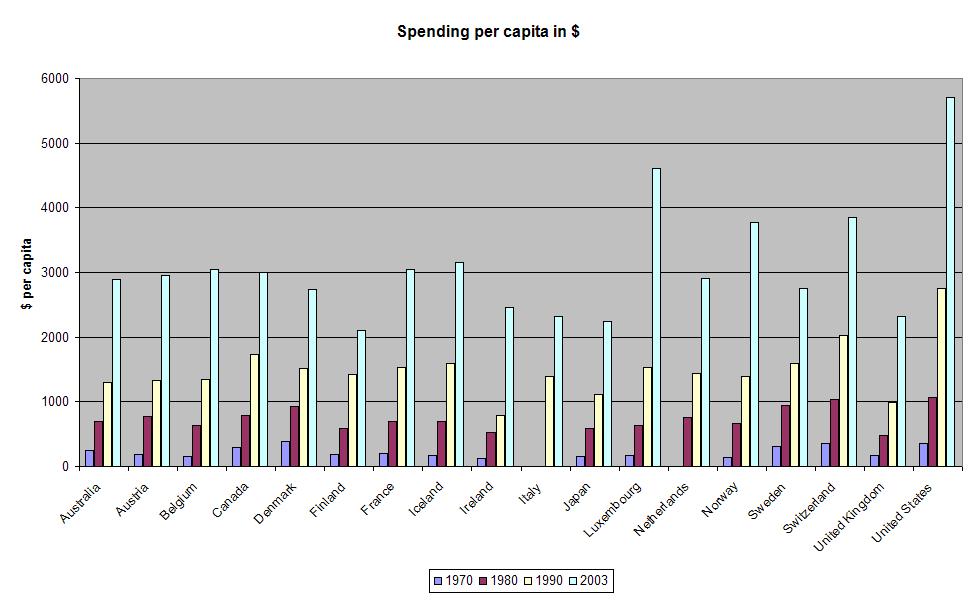
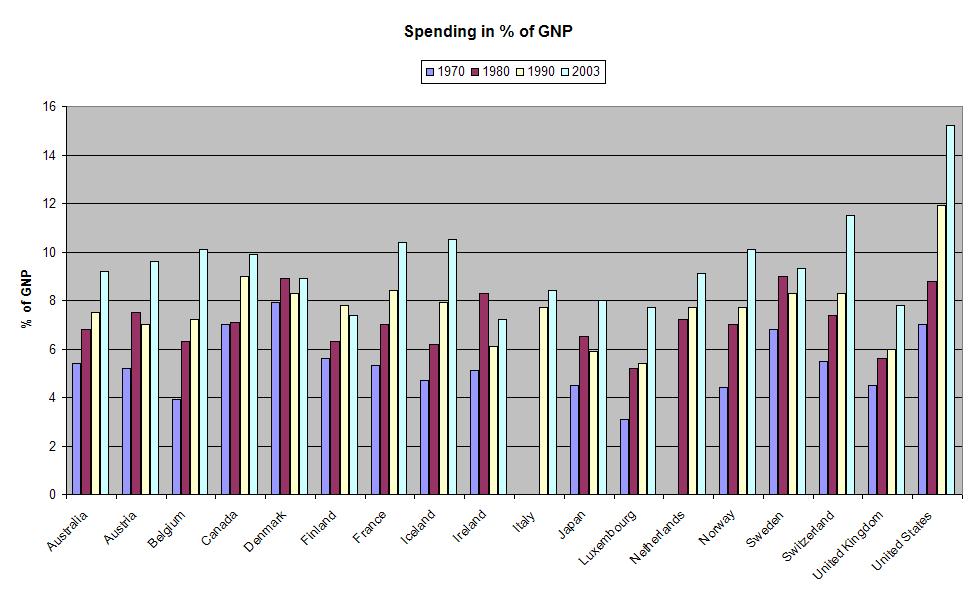
There is no doubt that the current US health care system is by far the most expensive in the world, both when considering cost per capita and percentage of GNP. This was not always the case, as you can see in the tables, the US was in the high end in 1970 and 1980, but in 1990 was far above the rest of the countries, and in 2003 even more so.


Source: Health Care Spending in the United States and OECD Countries

Health care quality

The counter-argument to the focus on health care costs is usually health care quality, so it’s necessary to take this into account. Since it’s hard to quantify what health care quality is exactly, I’ve tried to take a look on some health parameters published by the WHO.

The first parameter I looked at was life expectancy in the same countries as we looked at before. I know that my own home country, Denmark, ranks fairly low in this compared to other Western countries (mostly due to smoking and alcohol), and it’s something that there is great focus on in Denmark. Given this, it’s not too good that the US ranks equal to Denmark.


Other health care indicators are infant mortality and maternal mortality rates. Here the results are mixed. The US is the country with the highest rate of infant mortality, but is not quite as bad when it comes to maternal mortality. However, the US is still the country with the 4th highest rate (btw. what’s up with Luxembourg? That maternal mortality rate is quite frightening).


It seems like that the quality of health care in the US doesn’t do particularly well compared to other Western countries.

Availabilty of health care

Then, there is the availability of health care. I know that in Denmark, Australia and Canada there have been some debate about lack of facilities, so this seemed worth considering as well.
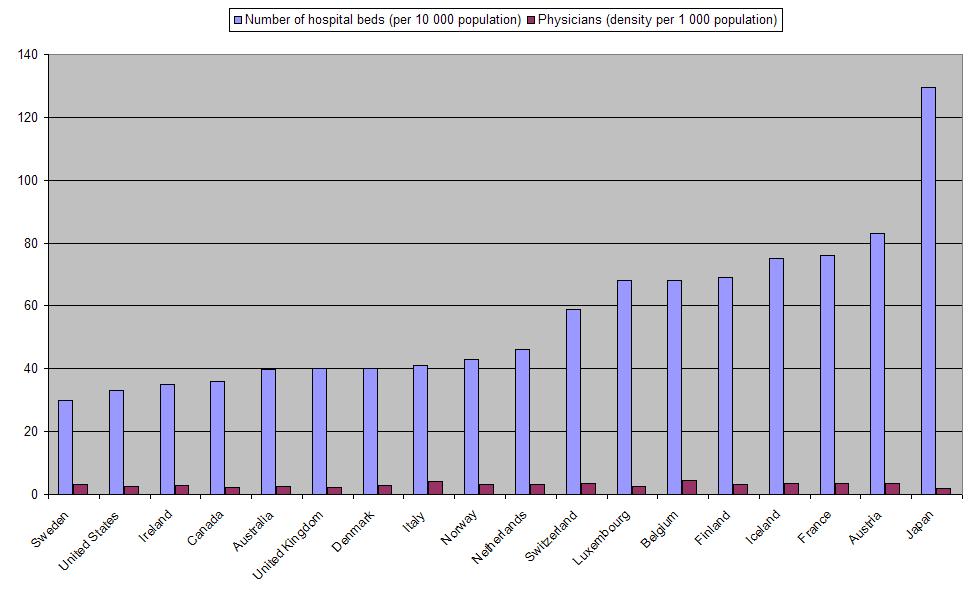
The US holds up little better in this regard. They are only the 5th lowest ranking when considering number of physicians per 1000 population, but are 2nd lowest (above Sweden) ranking when counting number of hospital beds per 10,000 population.


Government spending

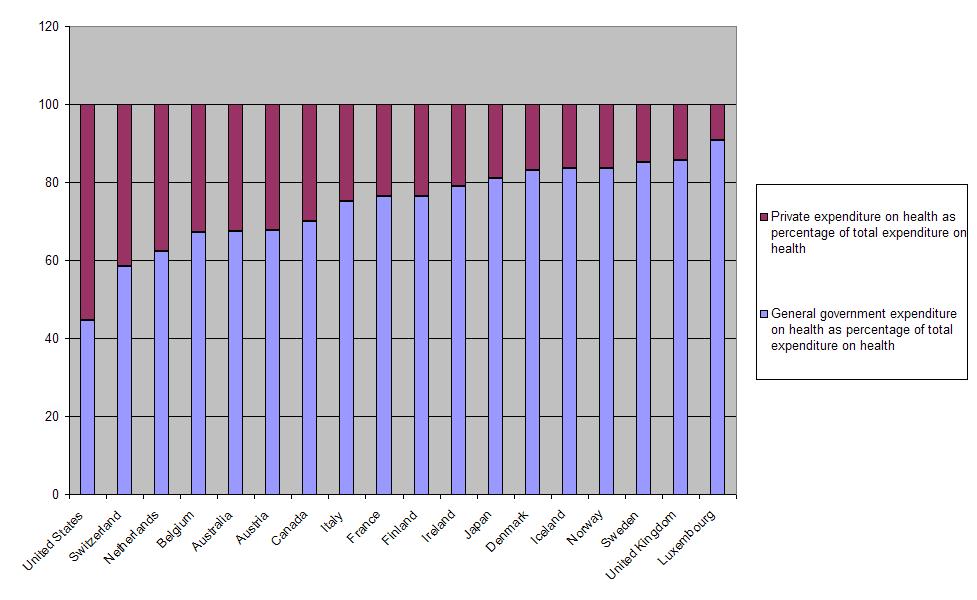
So all in all, Americans don’t seem to get much for their money. This might seem surprising, but when you consider the fact that private health care need a lot of administration, it might make sense. However, there is more to the story. When looking at the WHO data, I noticed that it was possible to see what percentage of the health care cost that is government and private.
Unsurprisingly, the US has a much lower percentage governmental expenditure than the rest of the Western world, but the number is probably much higher than many would expect. 44.6% of the total health care expenditure is paid by the government in the US.


As a matter of fact, when looking at government spending per capita, the US is ranking 7th, just below Sweden and Denmark, and when you take the relative buying power into consideration, the US is actually ranked 4th, above Sweden and Denmark.


Conclusion

As I have shown, the US not only uses more money on health care than any other country in the world, both per capita and as percentage of GNP, yet there are no indications that this have a positive effect on the performance of the US health care system. Not only that, the government expenditure per capita to health care is actually on par with countries with universal health care, especially when relative buying power is taken into account.
Given all this, it would seem that a shift to universal health care not only could result in little, or no, increase in government expenditure, without adverse effect on the quality and availability of the system. A shift to universal health care would also reduce private expenditure to health care, leading to an overall reduction of expenditure.

Labels: