Saturday, February 09, 2013

Marginalizing people


Back in September, I visited a Danish refugee camp together with a group of other people. The reason I went there, was that I wanted to get a better understanding of how Denmark treats refugees who have come to the country.

Refugee camps are places where people claiming refugee status live until their cases have gone through the process. Until recently, these people were not allowed to live outside those camps - a new law has loosened up those requirements, but the majority still have to live there, as there is no-where else for them to live.

Refugee camps are usually set up in old institution, such as former mental hospitals and foster homes, or in old military compounds.

I am, and have always been, against refugee camps for a number of reasons, the most important being that they marginalizes the people living there. People living in refugee camps are not living in a normal setting, and they cannot do a lot of everyday things the rest of us takes for granted. 

My visit to the camp made this even more clear to me. We visited a camp called Avnstrup, which is about an hour away from Copenhagen going by train and bus. Half an hour on each.

The above picture is of the bus schedule, which shows when the buses departs from Avnstrup - it is also the times when the bus arrives. This is the only bus which goes to Avnstrup, and for most people, there are no other means of transportation to and from the camp. 

I took the picture because I think it clearly shows how hard it is for people living there to go out and do anything - e.g. during the weekends, the bus only runs every three hours, and for a very limited period of the day. On Sundays, the first bus is at 12 and the last is at 9 PM - if you take into account the time spent on transportation, it only gives people 7 hours if they want to go into Copenhagen.

On weekdays, the last bus also runs at 9 PM, which means that if you've spent the day at some kind of study in Copenhagen, you won't really have time to do anything else than hurry home.

This is clearly a horrible way of getting people to integrate into society - keeping them isolated from it. Unfortunately, to some politicians, that's feature, not a bug.

Labels: , , ,

Sunday, April 29, 2012

Reducing the risk

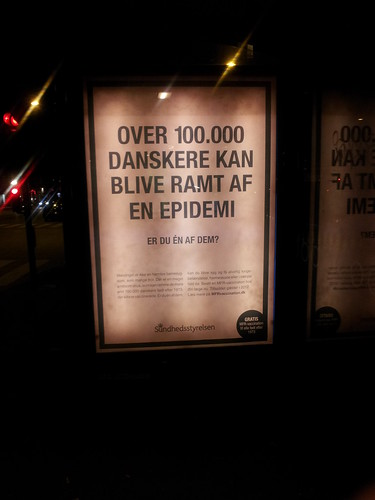
Measles warning by Kristjan Wager
Measles warning, a photo by Kristjan Wager on Flickr.

The Danish National Board of Health has started a new campaign, trying to make people get vaccinated against measles, offering free vaccinations to anyone born after 1973 (people born in 1973 and earlier will have to pay a fee).

The angle of the campaign is to make clear to people that measels isn't a harmless childrens' disease, but is quite dangerous.

The headline of the sign is "Over 100,000 Danes can be hit by an epidemic - are you one of them?"

Labels: , ,

Sunday, October 24, 2010

Foreigners moving to Denmark should be beware of church tax

In Denmark members of the state church (Folkekirken) pays church tax, which is collected from their pay checks together with other tax. The church tax depends on what municipality you live in, but in 2008 it was on average 0.8756% of your income. Considered that the average income for people who received a wage in 2008 was 284,065 kr. (approx. $53000), this amounts to more than 2000 kr. per year (approx. $375).

That's a fairly large amount of money going to the churches (on top of the money getting channeled from other taxes), but it is presumable acceptable if you're a member of the state church.

But what if you're not?

Well, in Denmark, church membership is tracked by a central register, or rather the central register, so for most Danes that's not really an issue. People who are baptized are members of the state church (at least until they actively leaves the church), while those who are not baptized aren't members (even though mistakes have been known to happen).

But what if you're not born in Denmark?

Well, if you live in Denmark, you will be registered in the central registry, based upon information you have provided when moving to Denmark. Theoretically this would mean that you won't pay any church taxes if you don't indicate that you're a member of the Danish state church (a check box on the form).

But this is only theoretically the case. The truth is, that many, perhaps even most, foreigner gets registered as member of the state church, and thus pays church taxes. I know several people this has happened to - in my last job it had happened to both a Norwegian and an Indian colleague of mine, none of which are members of the Danish state church (or any other state church for that matter).

So, if you're a foreigner who has moved to Denmark, make sure to check that you're not registered as a member of the Danish states church. If you are, make sure to complain to the municipality straight away, so you don't end up paying church taxes. If you already have paid church taxes, make sure to complain to the tax department, so you can get the money refunded - this might not be easy, so the earlier you discover your unwilling membership, the better.

Labels: , ,

Saturday, May 01, 2010

Make a decision before it's too late

There are certain decisions which will only come into effect after it's too late for you to choose. One of them is the decision whether your organs can be used after you're dead. This means that the decision is left to the grieving relatives, who are forced to face the issue just after their loved one has passed away.

This is a horrible situation to put them in.

Fortunately, many countries allows you to make the decision up front, stating whether you want your organs to be used or not, in case something happens to you.

In Denmark, this can be done through the website tagstilling.nu. Here you can enter your decision, and even indicate whether you want your relatives to be asked or not.

If you live in Denmark, I would ask you, if you haven't already done so, to think about the issue, and then register your choice. I am on the side of donating organs, but I accept that others don't feel the same way. But regardless of where you fall, please make a decision, and register it. It's important.

Labels: ,

Sunday, July 05, 2009

There is something rotten in Denmark

Since my readership is generally non-Danish, I tend to write little about Danish issues, but I feel that I've been too silent on the issue of Danish politics.

Denmark is lead by a two-party (Venstre and Konservative) right-of-center government which is dependent on the support by the populist, anti-immigrant Dansk Folkeparti.

Politically, I am not far from Venstre, but ever since Anders Fogh Rasmussen became the leader of the party, I've not voted for them, for the simple reason that I'm an anti-racist, and cannot support any party which works together with racist ideologues like the people in Dansk Folkeparti.

Unsurprisingly the support from Dansk Folkeparti comes with a price, and given their anti-humanitarian views, this price is paid by immigrants. Not only in the form of more and more draconian laws, but also in the form of widespread anti-immigrant rhetoric in the Danish society. Every time there is an issue involving immigrants (or descendants of immigrants) in one form or another, Dansk Folkeparti gets in front of the camera to demonize immigrants.

This has of course lead to a stigmatization of the immigrants in Denmark. In Denmark, children of immigrants are routinely referred to as "second generation immigrants" by politicians, the press, and the public, ignoring the fact that these people have lived their entire life in Denmark.

Of course, this doesn't happen to all immigrants. Even though my mother's not Danish, I don't get referred to as a second generation immigrant - as my picture shows, I look part of the homogeneous Danish population. Instead, it's people who comes from, or descents from people coming from, countries like Turkey, the former Yugoslavia, Iraq, Somalia, Libya, etc.

These people are also referred to as Muslim. When a Dane talks about someone being a Muslim, the Dane is not talking about someone belonging to a belief system, but instead uses it as an ethnic designation. It doesn't matter if the person in question is a Christian Lebanese, an atheist Dane, or something completely different - in the eyes of the Danish society, he or she is a Muslim.

This is perhaps related to the Danish perception of themselves being culturally Christian, no matter what their actual religions beliefs are.

All of this stigmatization has led to immigrants, and children of immigrants, becoming socially marginalized at a higher rate than others. Add to this the fact that people with a "Muslim" name have a harder time getting jobs, and you'll find people with a immigrant background are overrepresented in the criminal system, though nowhere as much as Geert Wilders claims. When he visited Denmark recently, he claimed that 70% of all prisoners in Denmark were Muslims; the true number is 20%, and in real numbers it's 800 people (out of 4000 prison inmates).

Currently there is a gang war going on between the biker gang Hells Angels and immigrant street gangs. This fight is about control of the illegal narcotic trade in Copenhagen, and has claimed lives of people in both camps as well as lives of innocent bystanders. Hells Angels are of course no strangers to such gang wars, having fought with Bullshit in the eighties and Bandidos in the nineties - the later gang war made headlines around the world when they started using rocket launchers.

Even though there are two sides to this conflict, and that one of the parts have been involved in several such conflicts in the past, the general public in Denmark apparently seems to think that the Hells Angels is the good part, fighting against the evil immigrants. Something which Hells Angels spokesman, and convicted murdered, Jønke has milked for everything it is worth.

Recently, Hells Angels published an manifest in which they talked about a group of people, called Jackals, that were dangerous to society, and which they fought against. These Jackals were of course a description of the stereotypical "Muslim" gang member. Most people could see through this obviously self-serving piece of propaganda, but some took it seriously. Among these, a member of Parliament for Venstre, Søren Pind, who wrote a blog post Hvad nu hvis Jønke har ret? ("What if Jønke is right?") where he looks at the manifest, ignoring the sender, and decides that the main message is correct, thus legitimizing further the public view of Hells Angels as the righteous side.

This is the current political state of Denmark.

At the same time, Denmark has recently elected a convicted racist, Morten Messerschmidt, to the EU parliament. Giving him the 2nd highest number of personal votes ever given to a candidate for the EU parliament. He is a member of Dansk Folkeparti.

Some times I despair.

What does it take for people to wake up, and see that Denmark is heading down the drain? Not because of the Islamification of the country, as the right-winged racists claim, but because of the continuous stigmatization of entire parts of the population. That the tolerance that Danes think Denmark represents, is not there anymore (if it ever was there)?

Denmark closed the borders for immigrants in 1972, and while people from the EU can move to Denmark if they want, all other immigrants either have to be refugees or have to have close family already living in Denmark. As per April 2009, there were 405,861 immigrants and 125,232 decedents of immigrants in Denmark, which makes them approximate 10% of the population. Of these, 247,672 and 108,651 were from "non-Western countries" (which includes Bosnia-Herzegovina). The source for the numbers can be found here (.pdf and in Danish)

Given the Danish population were 5,515,287 at the end of the first quarter 2009 (source), we're talking about approximately 6.5% of the Danish population who are "Muslim". Listening to the media and the right-winged, racist propagandists, you'd thought the number was at least 3 times as high.

There is obviously always challenges to integrating people in a new country, especially if they comes from a conflict-ridden area, but as many countries demonstrates, this can be done in much larger numbers than we are talking about here. It is, however, not done by stigmatization.

Denmark should do better - most of us are better than this.

Labels: , ,

Friday, June 05, 2009

Voting dilemma

In Europe, the voting for the EU parliament is currently going on, and in Denmark it happens on Sunday. At the same time, Danish voters are also asked to vote on a change of the constitution, which would change the rules regarding succession in the Royal family.

Currently the rules are that if the current monarch has one or more sons, the oldest son is the successor. In case there are no sons, the oldest daughter is the successor (in case there are no children, it gets more complicated).

The constitution change would result in men and women being treated equal, so it's always the eldest child, no matter their gender.

As a progressive, I have some serious problems deciding what to vote. Since I am very much for equal rights, I won't vote against, but I am debating whether I should vote at all. I regard the whole concept of royalty as outdated and abhorrent - the whole concept that someone gain privileges according to the law, solely because of their family ties, goes against everything I consider important. Voting yes to the constitution change could be seem to legitimize the whole system of royalty.

I know I am not alone in thinking this in Denmark, and many non-royalists are considering not voting, turning it into a referendum on royalty. If less than 40% of the eligible voters vote yes, the change will fail, regardless of the result.

Labels: , ,

Saturday, May 23, 2009

Fossil trading

I have previously briefly mentioned the publication of the new primate fossil, Ida. One thing I didn't mention in the blogpost was that the fossil was not a new finding, but rather a fossil bought from a private collector and then studied.

The Guardian has more on this.

Unearthed: the murky world of fossil collecting

This week, a 47m-year-old primate hailed as a missing link was unveiled, but it took an astonishing fee to bring it to light


I have some deep ideological problems with the thought of fossils being in the hands of private collectors without scientists having access to them. This means that any potential knowledge we might gain from those fossils is unavailable to the rest of humanity, until the owner either sells the fossils or allows others access to them. There is also a risk of damage to the fossils due to wrong handling and storage.

In Denmark there has since 1990 been a law which requires that all fossils should be turned in at a state run naturalistic museum which will evaluate it, and see if it is considered rare or valuable enough for the State of Denmark to buy it. If that's the case, the finder will receive a finders fee, depending upon the value of the object. Otherwise the finder can keep the object.

Up until now, approximately 450 fossils has been acquired by the state, gaining the status of danekræ (Dane creatures).

This seems like a reasonable way of doing it. The finder will either get to keep the fossil, or will get compensated, while the scientists (and the public) will have access to any rare or valuable findings.

Labels: , ,

Monday, March 02, 2009

Religion in Denmark and Sweden

A couple of days ago, the NY Times had a really great article on religion in Denmark and Sweden, which I thought I'd comment a bit on. The article is about both Denmark and Sweden, but I'll focus on the Danish perspective.

Scandinavian Nonbelievers, Which Is Not to Say Atheists

Phil Zuckerman spent 14 months in Scandinavia, talking to hundreds of Danes and Swedes about religion. It wasn’t easy.


I understand Zuckerman's problem when talking about religion. There are some very vast cultural differences between Danes and Americans relating this - the most easily apparent probably being the fact that it's considered rude to ask about peoples' religion. It's okay to talk about religion as a concept, but what peoples' personal religious views are, is not a subject which people feel comfortable asking about.

A simple example of this, is the simple fact that I have no clue about the religious views of neither my co-students nor my co-workers. I assume they are atheists, or at least agnostic, but I don't really know (my assumption is based upon the fact that all surveys show that majority of the younger generations in the area of Copenhagen are non-religious).

The many nonbelievers he interviewed, both informally and in structured, taped and transcribed sessions, were anything but antireligious, for example. They typically balked at the label “atheist.” An overwhelming majority had in fact been baptized, and many had been confirmed or married in church.

Though they denied most of the traditional teachings of Christianity, they called themselves Christians, and most were content to remain in the Danish National Church or the Church of Sweden, the traditional national branches of Lutheranism.


Many Danes are what can be called "cultural Christians", in the sense that they identify as Christian, but don't really believe in any god. Even if they don't identify as Christian, it doesn't mean that they are not members of the state church. I've been an atheist all my life, but even so, I was a member of the church for years.

The Danish atheist society (Ateistisk Selskab) try to convince people to leave the church by explaining how much they pay in church taxes, rather than arguing that they shouldn't be members when they don't believe in a god.

At the same time, they were “often disinclined or hesitant to talk with me about religion,” Mr. Zuckerman reported, “and even once they agreed to do so, they usually had very little to say on the matter.”

Were they reticent because they considered religion, as Scandinavians generally do, a private, personal matter? Is there, perhaps, as one Lutheran bishop in Denmark has argued, a deep religiosity to be discovered if only one scratches this taciturn surface?

“I spent a year scratching,” Mr. Zuckerman writes. “I scratched and I scratched and I scratched.”

And he concluded that “religion wasn’t really so much a private, personal issue, but rather, a nonissue.” His interviewees just didn’t care about it.

Beyond reticence, Mr. Zuckerman found what he terms “benign indifference” and even “utter obliviousness.” The key word in his description of their benign indifference is “nice.” Religion, in their view, is “nice.” Jesus “was a nice man who taught some nice things.” The Bible “is full of nice stories and good morals, isn’t it?”

Beyond niceness came utter obliviousness.


People don't really care about religion. If someone talks about their personal religion, or perhaps even tries to argue for a specific viewpoint, based upon religion, they are generally considered very religious, bordering on being extremist. On the other hand, people who are too vocal in their opposition of religion are also considered somewhat extremist. "Can't we all get along without pushing our religious views on others" seems to be the general view.

When Danes travel in the US, they are always taken aback by questions on religion and religious views, as these are taboo in Denmark.

As I said, it's a really great article, so if you haven't read it, go read it. Hopefully it gives people something to think about.

Labels: , , , ,

Saturday, December 06, 2008

The strange case of IT Factory

The Danish IT sector, and indeed the entire Danish business world, has been shaken in the recent week, by the story of how one of the most successful growth stories in recent years have turned out to be pure fiction, based on massive fraud.

For my Danish readers, there won't be any news in this post, as the Danish press has been covering the story extensively. I haven't, however, found any international coverage, except some coverage of the fact that the Bjarne Riis' cycling team has lost one of its major sponsors.

The company in question, IT Factory, and was a mixture of a software house, a consulting company, and some sort of license dealership for, among others, IBM.

In 2003 the company went bankrupt, and some investment partners bought it up, and inserted a new daily leader, Stein Bagger. Under his leadership, the company turned around pretty fast, and started to show impressive growth, becoming one of the market leaders, according to its yearly financial reports.

In the last couple of years, the company has won a number of awards by among other Børsen (a daily business newspaper), Computerworld, and Ernest & Young, because of its impressive numbers.

A lot of us in the business were somewhat puzzled by this, since no one appeared to neither actually know quite exactly what the company was doing, nor know anyone who had worked there, or worked together with anyone from there. That might not sound so weird, but the IT consulting business is not that big in Copenhagen, so odds are that you've worked together with someone from any of the major players in the market.

Of course, such things matter little, compared to the results, and we were all impressed by the financial reports from them.

Then, last week, the truth began to appear.

The head of the board of directors of the company, Asger Jensby, went public with the news that Stein Bagger had disappeared a couple of days before, while at a business conference in Dubai with his family (leaving his wife and his daughter behind).

The same day Bagger disappeared, Asger Jensby had found out that Bagger had told someone else, a business partner Alan Vestergaard, that they (Bagger and Vestergaard) would take over the company from Asger Jensby. Vestergaard was under the impression that everyone was in agreement about this, but Jensby had never heard about this before.

This, combined with Bagger's disappearance, led Jensby to start an investigation. The first couple of days, the investigation lead nowhere - everything appeared in order - but then they found a secret office that Bagger had leased close by, in which they found some incriminating documents.

This lead to Jensby going public with the news of Bagger's disappearance, and the news that it appeared that there had fraud in the region of $100 million. At the same time, the company filed for bankruptcy.

Following these news, there have been more investigations into the matter, and the fraud appears to be closer to $200 million.

Naturally, the question arise: How could this go on, without anyone knowing?

It seems that Bagger used a number of fake companies all over the world, selling and buying stuff to and from IT Factory, thus inflating its income, while enabling him to get money out of the company.

More precisely, what appears to have happened, is that Bagger would make a fake company that would sell some computers to IT Factory. Bagger would then go to a leasing company, making a deal with them, getting them to pay for the computers in exchange for a leasing deal on those very computers.
Of course, no actual computers existed, but only Bagger knew that.

Then, when time came to pay the leasing rate, Bagger would use another fake company to buy a bunch of licenses - enough to pay the bill for the leasing.

Any given rate of the leasing is of course much smaller than the entire sum, so even if it was 10% of the cost, there would still be 90% of the money left. And there would still be no computers.

Stein Bagger appears to be a very charismatic person, who were able to convince people that whatever doubt they might have, were unfounded. This explains why none of the members of the board of directors started to ask questions, or rather, why he was able to convince them that they didn't need to see some information on the customers, when they asked about them.

Another factor was of course greed. The company appeared to be going really well, and the customers always paid on time.

Still, some people were asking questions. A freelance journalist, and blogger, Dorte Toft (link in Danish) had raised some very serious questions when the Danish Computerworld gave IT Factory the prize for IT company of the year a few months back.

Her digging showed that there were serious questions that one could raise about IT Factory, and even more so about their customers. As a matter of fact, the two customer cases that Computerworld got for their article about IT Factory when they received the prize, were run by two Swedish men who had been found guilty of fraud in the past.

The Danish tax department were also investigating the company for fraud with sales taxes. Something any member of the board of directors should have seen as a serious warning sign.

In other words, the warning signs were there, one just had to look for them. Maybe it would not lead one to realize how badly the situation was, but it would lead one to understand that there was something very wrong.

My prediction is that there will be some legal procedures happening against the board of directors, and I'll also predict that at least Jensby will found guilty according to the rules of the liability for the board of directors. I also think that the accounting company responsible for signing off the company's financial records, KPMG, will get fined.

Update: It appears that Stein Bagger has turned himself in at a police station in Los Angeles. I'll write more about this case, as the story develops.

Labels: , , , , ,

Saturday, October 11, 2008

This hardly makes me proud of being Danish

The Times has an article title Denmark ‘has failed friends too’. It's the story of the Iraqi interpreter Mohammad who worked for first the British troops and later the Danish troops before fleeing to Denmark.

He fled to Denmark with his family earlier this year under protection from the Danish military, whom he had served for 18 months.
Related Links

Mohammad, who is 40, expected job opportunities as an English teacher, schooling for his children and, perhaps, a modest home where necessities were a stroll away. Instead he was given a halfway house, granted an 8,000 kroner (£850) monthly government payment and told to sort out the rest of his affairs on his own. “If I had thought life was going to be like this, I would not have come here,” he said in an interview conducted in Arabic. “I would prefer to live in danger in Iraq than to live here.”


I know that among many people, Denmark has a reputation for tolerance, but that's a thing of the past, if it ever held true. The Danish political environment has become more and more anti-immigrant. Not only has parties like Dansk Folkeparti (Danish People's Party) gained more and more influence, but other parties have kept busy trying to catch up on their anti-immigrant politics, to avoid using votes. The current Danish government, is entirely dependent upon the support of Dansk Folkeparti (DF) to stay in power, which has the natural consequence that DF rules the day, when it comes to their core issue - anti-immigration.

I had hopes that the Minister of Refugees, Immigration and Integration, Birthe Rønn Hornbech, would show a little backbone, as she has shown herself to be principled in the past, but it seems that she doesn't have the political courage it takes.

The very fact that we actually have a minister of Refugees, Immigration and Integration, shows how much these issues dominates Danish politics.

Labels: , , , , ,

Friday, March 21, 2008

Anna David's The Little Girl

A few months ago, the Danish music artist Anna David released a new album, on which there was a song "Den Lille Pige" (trans.: The Little Girl).

The song generated some notice in Denmark when it was released, because it was about rape and the costs of it. Not only that, it was a deeply personal song, about Anna David's own rape, when she was seventeen. She made a song about it to help others in the same situation.

I hadn't heard it before today, but the song is deeply moving, especially if you know the back story. Sadly, I haven't been able to find an English version of the text, but the music video is below. The chorus is something like

Outside no-one can see it, but it is inside.
You took something that for ever changed the small girl.
Even though she is grown up now, she'll never forget you.
Believe me words, because the little girl was me.


I liked some of her earlier stuff, but my respect for her has increased a lot.

Labels: , , ,

Wednesday, October 24, 2007

Election time

There have been a couple of elections in Europe lately.

In Poland Jaroslaw Kaczyński lost, and a more sane government is expected to form. You know that you're unpopular when both Russia and the EU is happy that you lost. Unfortunately, his twin Lech Kaczyński is still the president of Poland.

Switzerland also held elections, with the rightwing Swiss People's Party as the big winner, getting 30% of the votes. The largest block ever received by a Swiss political party. They have stated that they are going to form a broad coalition government, but there is no doubt that the result will pull Switzerland to the right, and towards harsher anti-immigrant measures.

And today the Danish prime minster announced that Denmark will have an election on November 13th. This was not unsurprising, as the government has risen in recent polls, and stands to win the election, with the help of their support party, Dansk Folkeparti.

Danish politics are quite confusing to outsiders, with parties spanning from the Anarcho-communist Enhedslisten (the Unity List, a coalition of a number of far-left parties), over the more traditional socialists, social democrats and conservatives parties to the right-wing, anti-immigrant Dansk Folkeparti (Danish Peoples' Party). However, the current political situation can be briefly be summed up thus:

Normally Danish politics is formed by consensus across a broad political spectrum, but during the current government, Danish politics is best characterized as block politics, with the right-winged government parties Venstre (literately translated as Left), a typical liberal party in the European sense, and Det Konservative Folkeparti (the Conservative Peoples' Party), being supported by the anti-immigrant populist party Dansk Folkeparti.

Against them stands a coalition of 4 center-left parties, will try to get the leader of Socialdemokraterne (the Social Democrats) elected as prime minister. There are some very big differences between the parties in this coalition, and if they win the election, it would probably mean that the new government would have to form consensus across the middle to the two current government parties on a number of issues.

Personally, I just about don't care what the results will be, as long as Dansk Folkeparti looses their influence. I consistently vote against them, and try to optimize my vote to have the greatest negative impact on their power. I'd rather have the far-left people in power, even though I'm pretty sure it would lead the country to bankruptcy if kept up for too long.

Labels: , , , , ,

Saturday, September 15, 2007

A general warning when communicating with me

Or any other Danish person.

Today, new laws steps into effect in Denmark, that leads to all emails and text-messages getting stored by internet and phone providers. All phone calls from Danish phones and web-browsing from Danish computers (through Danish internet providers) also get registered.

This is an anti-terror measure.

Of course, it's entire ineffective, since the law only governs within Denmark, so email accounts in other countries (e.g. gmail, hotmail, yahoo etc.) are not stored, even if owned by Danes. And within Denmark, it can easily be bypassed.

The law is not as wide sweeping as some seen in the US - Danish police/intelligence agencies cannot get access to this data (which is gathered and stored by the providers) without a court order. Still, it's open for abuse, and a very bad step towards less privacy.

Unfortunately there is widespread support for these laws among politicians. Only the hard-core socialists (Socialist Folkeparti) and the communists (Enhedslisten) voted against it.

The union for programmers and systems developers (Prosa) is very much against this law, and has created a free CD containing some freeware to help people annonymize their internet usage. An image of it can be downloaded here (page is in Danish). Alternatively, I suggest installing Tor.

Labels: , ,